In 2004, one of the most influential papers in healthcare design, “The Business Case for Better Buildings,” was published in Frontiers of Health Service Management. Using existing data, its authors, Leonard Berry, the late Derek Parker, the late Russ Coile, Kirk Hamilton, David O’Neill, and Blair Sadler made a compelling case that spending more money upfront to build a better hospital could save money of the live of the building.
Parker told me back then that he came up with the idea while tweaking a presentation he was giving at a conference. The night before, he changed his whole presentation and instead told the story of the Fable Hospital. He then engaged colleagues he knew from The Center for Health Design to collaborate in writing the paper.
At the time, the idea seemed almost radical.
But the authors argued that better design could reduce infections, improve patient outcomes, decrease staff injuries, increase satisfaction, and lower operating costs. Their fictional “Fable Hospital” demonstrated that using evidence to make design decisions wasn’t simply the right thing to do—it was good business.
Seven years later Berry, Hamilton, Sadler, Parker and a few others expanded on that work, publishing, “Good Health Care by Design” in the Hastings Center Report. This Fable 2.0 paper incorporated new research and reinforced the financial value of an evidence-based design approach.
Now, 15 years after that update, Berry, Hamilton, Sadler, along with lead author Ashley Dias and others have published “Fable Hospital 3.0: The Business Case for Building Better Healthcare Facilities” in BMJ Leader.
While it builds on the same foundation, it represents something much bigger than another update. It reflects a fundamental shift in how we think about the role of hospitals in our communities.
The Question Has Changed
The original Fable Hospital papers asked a fairly straightforward question:
Can better hospital design pay for itself?
After more than two decades of research and real-world experience, that question has largely been answered.
Today, using an evidence-based design process to design healthcare facilities is no longer a fringe idea. Private patient rooms, access to daylight, views of nature, healthier materials, and environments designed to reduce infections and errors have become mainstream features.
Fable Hospital 3.0 assumes those principles work.
Instead, it asks a much broader question:
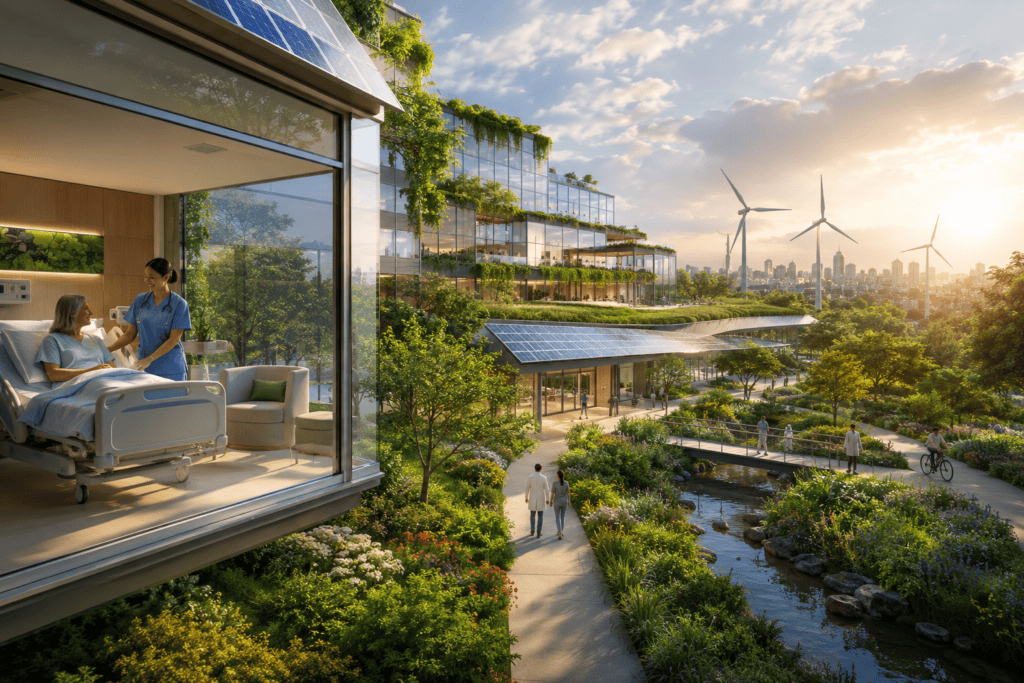
How can hospitals become regenerative assets that improve human health, strengthen communities, and restore the environment—while continuing to deliver a strong financial return?
That’s a different conversation.
Hospitals Face a Different Set of Challenges
As we all know, healthcare has changed dramatically since 2004.
Hospital leaders are still focused on patient safety and quality, but today’s challenges extend far beyond the walls of the patient room.
Health systems are dealing with workforce shortages, clinician burnout, an aging population, more complex chronic disease, climate change, supply chain disruptions, cyber threats, and increasingly severe weather events. At the same time, hospitals are integrating rapidly evolving technologies while navigating relentless financial pressure.
The modern hospital isn’t simply a place to deliver care. It has become critical community infrastructure.
The newest Fable Hospital recognizes that reality.
From Sustainable to Regenerative
Perhaps the biggest conceptual shift in Fable Hospital 3.0 is its embrace of regenerative design.
For years, many hospital and health system leaders have talked about sustainability—reducing energy use, conserving water, lowering waste, and minimizing environmental impact.
Regenerative design goes a step further.
Rather than simply doing less harm, regenerative buildings actively improve the health of the people, communities, and ecosystems around them.
That means designing hospitals that strengthen resilience during disasters, improve neighborhood walkability, support biodiversity, restore local watersheds, reduce carbon emissions, create healthier indoor environments, and connect patients, staff, and visitors with nature.
Flexibility Becomes a Strategic Investment
One of the most interesting additions in Fable Hospital 3.0 has little to do with patient rooms or gardens.
It’s flexibility.
Healthcare is changing faster than our buildings. Hasn’t it always been that way?
Medical technology is rapidly evolving. Care delivery models continue to shift toward outpatient settings. Clinical programs expand and contract. New equipment requires new infrastructure.
Instead of designing fixed spaces that become obsolete, the newest Fable Hospital promotes adaptable infrastructure, modular construction, prefabricated patient headwalls, demountable walls, and flexible building systems that make future renovations easier and less expensive.
That’s an important evolution in thinking, don’t you think?
The most sustainable building isn’t simply one that uses less energy or has a lower carbon footprint. It’s one that continues serving its purpose for decades without requiring major demolition and reconstruction every few years.
The Business Case is Stronger Than Ever
Despite its broader vision, Fable Hospital 3.0 never loses sight of the bottom line.
The authors estimate that investing approximately three percent more in construction on a 300-bed hospital can be recovered within the first two years of operation – and the potential savings over a 10 year period could be over $100 million.
Savings come from familiar areas such as reduced length of stay, fewer medical errors, lower staff turnover, and decreased energy and water consumption.
But the financial model is now much more comprehensive.
It also recognizes savings from flexible infrastructure that lowers future renovation costs, resilient operations that minimize disruption during emergencies, and construction strategies that reduce material costs and speed project delivery.
The business case has evolved from demonstrating that good design saves money to showing that high-performance hospitals create value across the entire life cycle of the facility.
Looking Ahead
Reading all three Fable Hospital papers together offers a fascinating snapshot of how healthcare facility design has matured over the past 22 years. (You can find them on The Center for Health Design’s Knowledge Repository by searching for “Fable Hospital.”)
The original paper had to convince healthcare leaders that design mattered.
The second demonstrated that the evidence had become overwhelming.
The newest version assumes that using an evidence-based design process is simply the starting point.
The conversation has shifted from designing buildings that are less harmful to designing hospitals that actively contribute to healthier people, healthier communities, and a healthier planet.
As healthcare organizations continue making once-in-a-generation capital investments, that may be the most important lesson of all.
The question is no longer whether better design is worth the investment.
The question is whether we can afford not to build hospitals that are prepared for the challenges—and opportunities—of the next 50 years.
Who will build the first Fable 3.0 Hospital? Or has it already been built? Weigh in with your comments in the box below.
P.S. Please do me a favor — if you liked this post and like this blog, please share it with others by sending them the link or posting it on your LinkedIn, X, or Facebook. Also, don’t forget to subscribe, so you’ll get emails when new content is posted. Thanks!