
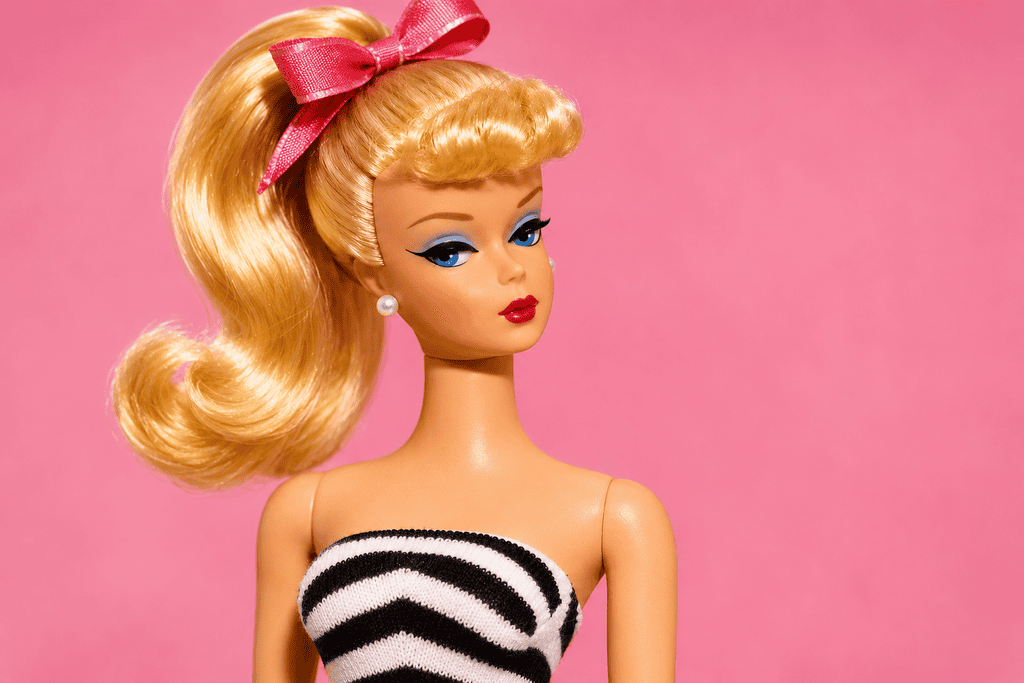
I don’t remember exactly how old I was when I got my first Barbie, but my earliest memories of playing Barbies are from when I was 5 or 6 years old, living with my family in a two-bedroom house on Golfview Drive in Urbana, Illinois.
My sister and I set up a house for our Barbies in our shared bedroom closet. Barbie lived there with her younger sister, Skipper. Her redheaded best friend, Midge, was always hanging around, too.
Barbie’s boyfriend, Ken, was part of the household, but he wasn’t particularly important. They had what we’d now call a “situationship.”
“Barbies” was our collective name for all of them.
I was fascinated by Barbie’s big boobs, tiny waist, and perfect legs. I didn’t know any real women who looked like that. Even at that young age, I sensed that Barbie was sexy, although I didn’t really understand what that meant.
Our Barbies had plenty of clothes, most of them lovingly handmade by my Grandma Gove or Aunt Wanda. Their tiny shoes were forever falling off their permanently arched feet.
Perhaps as a reflection of his insignificance, Ken had no wardrobe. He went bare-chested, wearing only a swimsuit to cover his anatomical private parts.
Christmas was usually good to our Barbies. One year, they got a convertible and a beach house. Another year, GI Joe arrived as a more manly alternative to Ken. Rather than becoming jealous, Ken befriended Joe, probably hoping he could borrow some of his fatigues.
At some point, my sister fancied herself a hairdresser and, without my permission, cut our Barbies’ hair. Fortunately, she couldn’t butcher Ken’s hair because it was molded plastic.
I was understandably annoyed by this audacious act. But what could I do? The damage was done. Barbie’s perfect hair would never be the same.
Our family moved from Urbana to Normal, Illinois, when I was starting fourth grade. By then, my sister and I had largely abandoned our Barbies for books, board games, records, Bobby Sherman, and Davy Jones.
How Barbie Came to Be
Looking back, I realize there was a lot more going on with Barbie than two little girls playing in their closet.
Barbie debuted in 1959, the year I was born. Her creator, Ruth Handler, cofounder of Mattel, got the idea after watching her daughter Barbara play with paper dolls depicting grown women.
At the time, most dolls were babies, encouraging little girls to imagine themselves as mothers. Handler envisioned something different: a doll that would allow girls to imagine themselves as adults with lives and ambitions of their own.
Barbie was fashionable, independent, and unmarried. She had no children. Her first outfit was a black-and-white striped swimsuit, and she sold for $3.
Ken arrived in 1961, but as my sister and I seemed to understand instinctively, Barbie didn’t need him to have an interesting life.
This was postwar America, when marriage, motherhood, and homemaking were still widely promoted as women’s primary roles. Barbie was revolutionary because she suggested that girls could grow up to be something other than wives and mothers.
Over the years, Barbie became an astronaut, surgeon, business executive, and presidential candidate. She had her own house, car, wardrobe, and career ambitions.
Barbie could be anything she wanted to be.
As long as she was beautiful.
The Perfect Woman?
As a child, I loved Barbie’s clothes and the imaginary lives my sister and I created for her. I wasn’t consciously trying to look like her.
But as I grew older, I wanted to wear fashionable clothes and be pretty and attractive, particularly to boys and, eventually, men.
I don’t remember feeling overt pressure to meet a particular beauty standard. Perhaps that’s because cultural expectations don’t always arrive as explicit instructions. Sometimes we absorb them without realizing it.
In the 1960s, those messages came from television, movies, magazines, advertising, and beauty pageants. The Miss America Pageant, a nationally televised spectacle since 1954, celebrated an idealized version of feminine beauty, poise, and talent.
On movie screens, Marilyn Monroe and Jayne Mansfield embodied the voluptuous blonde bombshell. And there was Barbie, with her impossibly long legs, tiny waist, large breasts, flawless complexion, and perpetually youthful face.
I can’t help wondering how much these images shaped what girls of my generation considered beautiful.
Did Barbie influence our ideas about how women were supposed to look? Or did she simply reinforce beauty standards that already existed?
Probably some of both.
Young girls like me may not have wanted to be Barbie, but perhaps we absorbed something about beauty from playing with her.
There was certainly a contradiction in Barbie’s message. She encouraged girls to imagine limitless possibilities for their futures, yet she presented a remarkably limited vision of what a woman should look like.
She could have any career she wanted, but apparently, she still had to have a tiny waistline.
A Changing Ideal
As women’s roles changed during the 1960s and 1970s, Barbie changed with them. She reflected new fashions, lifestyles, and professional opportunities.
But she also became a target of feminist criticism for promoting unrealistic body proportions and a narrow ideal of female beauty.
Over time, Mattel expanded Barbie’s world to include dolls representing different races and ethnicities. Eventually, it introduced a wider variety of skin tones, hair textures, physical abilities, and body shapes.
In 2016, nearly six decades after Barbie’s debut, curvy, tall, and petite versions finally appeared.
Why did it take so long for Barbie to have a body that looked more like those of actual women?
The changes reflected a growing recognition that girls needed to see more than one version of beauty.
And perhaps that women didn’t need to look like Barbie to be beautiful.
Barbie, Where Have You Gone?
But back to my own Barbie story.
A few years after we moved to Normal, I came home from school one day and discovered that my mother had given all our Barbies to the younger girls next door.
Without asking us.
Apparently, she’d decided we were finished playing with dolls.
I’d babysat for those girls and knew what a disaster their playroom was. Our Barbies had disappeared into the chaos. I decided to let them go rather than attempt a rescue mission.
Still, I kind of wish I had one of those shorn-haired Barbies today.
Fortunately, all was not lost.
Many years later, my sister gave me two Barbies from the collection of a friend who had died of cancer. The woman had amassed more than 50 dolls, all still in their original packaging. With no grandchildren or nieces and nephews to inherit them, my sister took it upon herself to find good homes for her friend’s Barbies.
The two she gave me were New York Barbie and Ascot Barbie.
New York Barbie made sense because I’d spent 12 years working in New York City. Ascot Barbie was particularly meaningful because I’d loved the 1964 film “My Fair Lady” as a girl. I still do.
For those unfamiliar with the movie, “My Fair Lady” tells the story of Eliza Doolittle, a poor, outspoken Cockney flower seller whom Professor Henry Higgins sets out to transform into a proper English lady.
Higgins teaches Eliza to speak correctly, dress elegantly, and behave according to the rigid rules of upper-class society. His goal is to pass her off as a duchess.
One of her early public tests comes at the Ascot horse races, the ultimate gathering of London’s upper crust—a spectacle of wealth, extravagant fashion, enormous hats, and suffocating social etiquette.
Eliza arrives looking every inch the refined lady in a magnificent black-and-white gown and a matching hat. She’s doing beautifully, speaking in an exaggeratedly proper manner and blending in with the aristocratic crowd.
Until she gets caught up in the excitement of the race.
“Come on, Dover! Move your bloomin’ arse!” she shouts.
It’s one of the funniest moments in the film.
And one of the most revealing.
Higgins has transformed Eliza’s appearance and manners, but he hasn’t changed who she is. Her feisty, irrepressible personality comes roaring back the moment she forgets she’s supposed to be perfect.
The perfect lady turns out to be much more interesting when she stops being perfect.
Lfe in Plastic
That’s remarkably close to the message of Greta Gerwig’s 2023 film “Barbie,” nearly 60 years later.
In the movie, Barbie lives in a perfect pink world where everyone is beautiful, successful, and happy. But when she begins thinking about death, develops cellulite, and discovers that her feet have gone flat, her perfect existence starts unraveling.
She eventually ventures into the real world, where she discovers that being a woman is considerably more complicated than she’d imagined.
By the end of the film, Barbie makes a remarkable choice. She decides to become human rather than remain a perfect, ageless doll.
She trades eternal beauty for the messy, unpredictable experience of being alive.
I think about that when I look at my two collectible Barbies, still sealed in their original boxes. They remain exactly as they were manufactured, untouched by time and experience.
There’s something both beautiful and unsettling about that.
Barbie never ages, never gains weight, never gets wrinkles. She never experiences heartbreak, disappointment, or loss.
But she never experiences love, joy, adventure, or the satisfaction of overcoming life’s challenges, either.
When I was a little girl, I spent hours imagining stories for Barbie, dressing her up, and deciding what adventures she’d have next. She was the perfect woman, living whatever life I invented for her.
Now, I realize that perfection isn’t nearly as interesting as I’d once imagined.
Barbie will always look 19. But she’ll never know what it feels like to be 66.
Her loss.