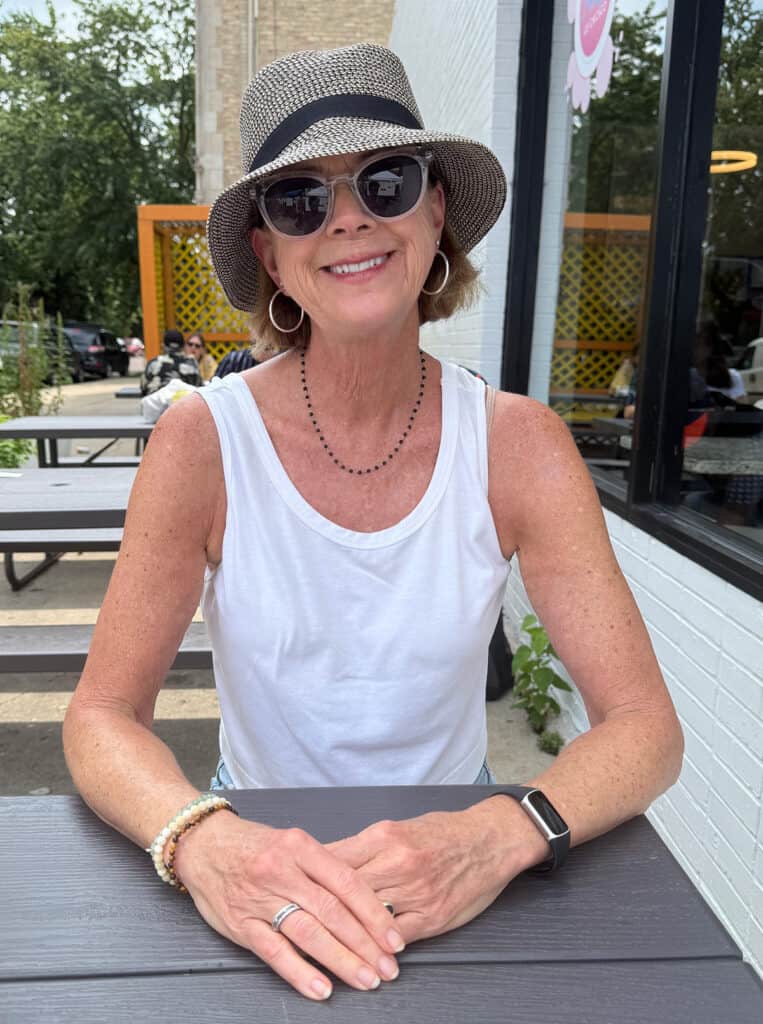
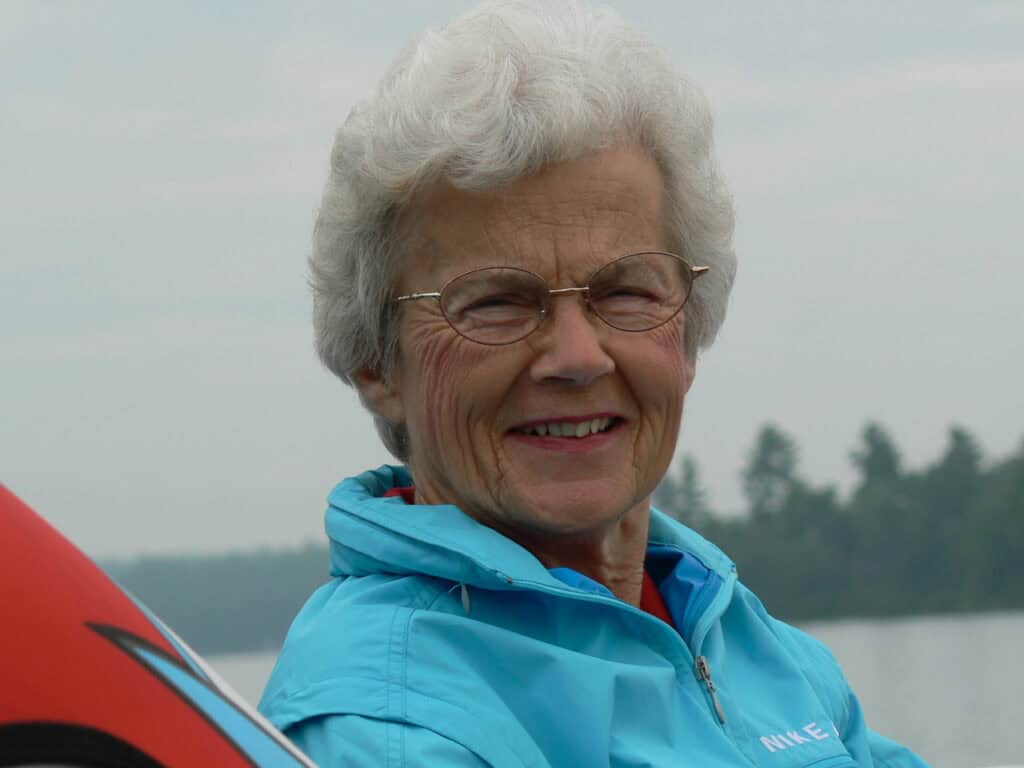
Harriet Joan Gove O’Daffer was born on a farm in 1933 in Newton, Iowa, where her father Sabin raised cows and sold milk for a living. A premature baby, her older sister Ellen said her head wasn’t any bigger than a teacup.
Sabin and his wife Mildred struggled to make a living on the farm during the Great Depression, eventually succumbing to the creditors. So, when my mom was three years old, Sabin moved his wife and three kids to working class Creve Coeur, IL, where he had found work on the factory floor at the Peoria Caterpillar plant. Mildred went to school to get an education degree and helped support the family by working as a third grade teacher.
If Mom had grown up on that farm, it’s possible that like her cousins Donna Ray and Nancy Kay, she never would have left Iowa. Instead of being a country girl, she became a city girl.
While my mother’s family didn’t have much extra money, Mildred and Sabin worked hard and had a pretty good life in Creve Coeur. The family dressed up and went to church every Sunday and Sabin managed to buy a new car every few years.
They built an addition on their tiny house to add the only bathroom and a master bedroom. Mom slept upstairs in a room with Ellen and younger brother Jack. Everyone helped tend the enormous garden that helped feed the family.
Mom went to Gerber Grade School, worked at Grant’s Department Store downtown Peoria, and graduated from East Peoria Community High School, where she served as student council president and was on the girl’s softball team.
Her dad didn’t want her to go away to college and pushed her to attend local Bradley University like her sister. “But I wanted to be a teacher,” Mom told me once. The best teacher’s college in the state just happened to be Illinois State University in nearby Normal, Illinois.
When Harriet Met Phares
My mother met my father in the library her freshman year at ISU. The story goes that he when he saw her in the library, there was a pencil sharpener on the wall near where she was sitting. He went over to sharpen his pencil to get a better look. When she came to check out her book, he struck up a conversation.
“I was shy,” she said. They got married in January of their senior year, because, as Dad recalls, “We were spending all our time together anyway and figured we should just get married.”
After graduation, Mom got a job as a fourth grade teacher while Dad worked as a high school math teacher. A few years later, Dad was drafted into the Army, completing basic training in August 1957 and sent to the Army’s Aberdeen Proving Grounds.
He was one of the lucky ones who got released a few months later because the Russians had just launched Sputnik and the U.S. government decided if science and math majors were working in their profession it might help us win the Space Race.
“By then, I was pregnant with your sister Sue, “ Mom said. “And you were born in Hammond, Indiana, 18 months after she was born. So I had my hands full.”
She never went back to work, instead raising us kids and spending her spare time volunteering for the church and various community groups – including serving as Board Chair for The Baby Fold adoption agency and president of the Unit 5 School District board.
At home, though, it was my dad who was president and she a quiet first lady. Perhaps if I’d seen her leading school board or Baby Fold meetings, I’d have had a different view of her. But like most children, I only saw her as my mom.
The Original Energizer Bunny
We called my mother the Energizer Bunny because she was in constant, steady motion. Going and going. She was not one to take a nap, yet could rarely sit through a movie at home without nodding off.
When our family was together, though, we could get her to sit and play games, like bridge, Scrabble, and Yahtze. She usually won. Mom often sat down on the carpeted floor of the great room of their Lake Bloomington house and Go Fish or Uno with her grandkids.
And she was pretty good with a ping pong paddle and a tennis racquet, too. Her lobs on the tennis court were legendary. “Get in there, dummy!” she’d yell as the ball went sailing toward the baseline.
When prompted, Mom was able to talk about politics or social issues, but she was often drowned out by the rest of us. It was usually Dad who tried to draw her into the conversation, a gentle reminder to all of us that she had opinions, too.
A Different Sense of Humor
Mom’s sense of humor was different than the rest of us. She rarely said anything to be funny, nor was she inclined to engage in our group silliness.
She didn’t laugh at most of the things we did – like the stories from our childhood that we found ridiculous. Stories like the one about our dog Buffy, who used to poop in the basement behind the pool table at our Gregory house.
My dad, whose office was in the basement at the other end of the pool table, would ignore the poop, sometimes for days. At some point, someone else – usually one of us kids who’d come down to play a game of pool with our friends – would see the petrified poop, and that’s when Dad’s rule of “You Saw It First, So You Get To Clean It Up” went into effect.
I still laugh when I think of that whole scene, but my mom never did. Acting silly or talking about poop just wasn’t part of her DNA. On the flip side, I never saw her get mad very often. She kept her emotions in check, focusing on the more practical matters of taking care of her family.
A Wonderful Grandma
When the grandkids were born, Mom’s gentle, nurturing, supportive personality blossomed. She’d coo and smile at the babies and they’d coo and smile back. She’d bathe and dress them, singing softly as she rocked them to sleep.
The day my son Wes was born, Mom got on a plane at the crack of dawn in Chicago to fly to New Jersey. She stayed with us for two weeks.
During that time, she taught me how to take care of my baby and took care of me, too – letting me rest or sleep while she cooked or did the laundry. I cried when she left to go back to Illinois.
A week later, when Wes started crying all day long, Mom helped me learn how to be patient and find ways to cope with his discomfort. She was the one who gave me the best comfort and support during that difficult period of change in my life. It made me appreciate and love her in a totally different way.
Losing Her Memory
When Mom first started having memory problems, we asked Dad what we could do to help her. His answer was, “Just show your mother that you love her.”
At first I didn’t know how to do this.
It drove me crazy that Mom couldn’t remember things like what movie she saw the night before or that we’d have to tell her over and over where we were going that day. I hated that she did strange things like wearing the wrong clothes, washing all the dishes by hand instead of putting them in the dishwasher, and putting the blue towels in the brown bathroom and the brown towels in the blue bathroom. Or forgetting to pack any shoes for a week long vacation in Wisconsin.
But I came to understand that for someone with memory problems, the best you can expect is for them to live in the moment. It didn’t matter if Mom didn’t remember what you said to her five minutes ago or forgot how to do things.
It mattered what you said or did in the moment that she was engaged with you. Like giving her a hug, helping her find the bathroom, or asking a question that brought back a good memory. Whether she answered you or not.
Life Everlasting
My mother passed away in September 2020 after a 13-year battle with Alzheimer’s. She was in the advanced stages of the disease and while she was still living with my father, we knew those days were numbered.
When she fell and broke her hip, we decided against surgery and put her in hospice care. Mom died peacefully and quickly four days later, surrounded by the husband, children, and grandchildren she loved so much.
I felt grief and profound sadness, but also also relief that she was finally in a place where she could remember all the happiness in her life and the people who loved her. Rest in peace, sweet mama.