
I’ve lived just north of Chicago for more than 30 years. Yet lately I’ve realized that there are countless places in this city I’ve never visited and neighborhoods I’ve never really explored.
It’s easy to think you’ve “done Chicago” because you’ve taken the “L” to a Cub or Sox game, strolled the River Walk, visited the Art Institute, and spent time in Millennium Park. But this city has layer upon layer of history waiting to be discovered.
That’s why I signed up for an OLLI study group exploring Graceland Cemetery.
Not Just a Cemetery
At first glance, it may seem like an unusual place to spend a summer morning.
But Graceland isn’t just a cemetery. It’s an outdoor museum, arboretum, and a history book all rolled into one. Many of the people buried there helped build Chicago into the city we know today.
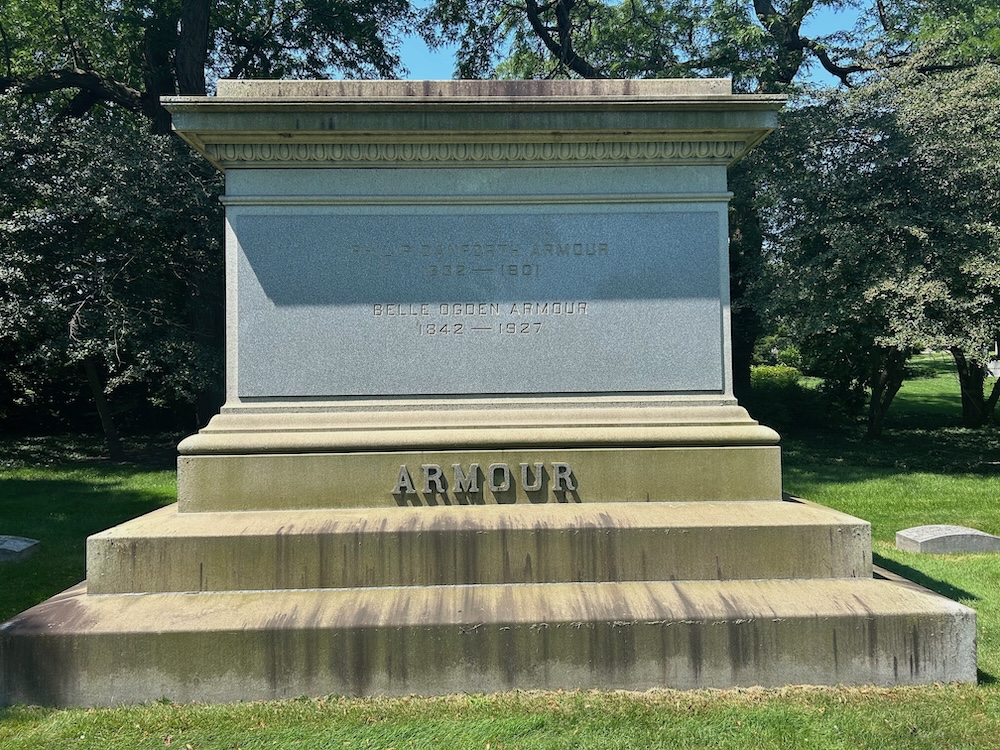
Each study group participant was assigned people to research. My first assignment was Philip Danforth Armour.
Like many people, I knew the Armour name because of the meatpacking industry. What I didn’t know was how much he influenced Chicago—not just economically, but educationally.
Go West Young Man
Armour was born on a modest farm in Stockbridge, New York, in 1832, the fourth of eight children. As a boy, he learned to raise livestock, butcher animals, and even make soap from rendered animal fat—skills that would unexpectedly prepare him for his life’s work.
At age 20, he headed west during the California Gold Rush. Ironically, he didn’t make his fortune mining for gold. He made it selling food and supplies to the miners.
By the time he left California, he reportedly had about $8,000, a considerable sum at the time.
After operating food businesses in Cincinnati and Milwaukee, Armour moved to Chicago and founded Armour & Company in 1867.
The company became one of the largest meatpacking firms in the world and helped establish Chicago as the global center of the meatpacking industry. The Union Stock Yards fueled the city’s extraordinary economic growth and created thousands of jobs.
Of course, that success came with a darker side.
The stockyards became notorious for dangerous working conditions, exploitation of immigrant labor, and unsanitary food processing—conditions famously exposed by Upton Sinclair in The Jungle. It’s a reminder that history is rarely simple. Many of the people who transformed cities also left behind complicated legacies.
A Million Dollars
But Armour’s legacy to Chicago had nothing to do with meatpacking.
In 1890, Chicago minister Rev. Frank Wakeley Gunsaulus delivered a sermon titled “What I Would Do If I Had a Million Dollars.” Rather than asking for money outright, he described his dream of creating a school where young people could receive a practical education in engineering, science, and industry, regardless of their financial means.
When Armour heard about the sermon, he invited Gunsaulus to breakfast.
After hearing more about the vision, Armour wrote a check for one million dollars.
That gift established the Armour Institute of Technology, which eventually became today’s Illinois Institute of Technology.
I love that story. Not just because of the extraordinary generosity, but because it all began with one sermon, one conversation, and one person willing to invest in someone else’s dream.
Stories Behind the Names on the Gravestones
Armour and his wife, Belle, lived on South Prairie Avenue, then the most prestigious address in Chicago. Their neighbors included George Pullman, Marshall Field, and William Kimball—the people who literally built modern Chicago. Yet contemporary accounts describe Armour as someone more interested in business and philanthropy than fashionable society.
He died of pneumonia in Chicago in 1901 at age 68.
Walking through Graceland, it’s easy to see elaborate monuments and think only about wealth and power. But learning the stories behind the names on the gravestones makes the experience much richer.
Some of these people changed industries. Some changed skylines. Some changed education. Many changed lives in ways that continue to shape Chicago more than a century later.
Sometimes the best adventures aren’t thousands of miles away. Sometimes they’re hiding in your own backyard, waiting for you to slow down and finally take a closer look.