The fall that I was to turn 13, my mom and dad finally agreed to buy me a horse. “Save up $30,” my dad told me, “and then we’ll go buy you a horse.”
Those words were magic to my adolescent ears. To have a horse of my own had been my dream for years.
I had read every horse book I could get my hands on, seen every horse movie, and collected and played with Breyer horse models in my room for hours on end.
But the closest I’d been to a real horse were the ones at the Lost Valley dude ranch where my family vacationed one summer in Colorado, others on occasional campground trail rides, and the old pony Jackie at my grandparents’ farm.
I actually thought $30 would buy a horse. So I mowed the lawn, babysat, and did other odd jobs to save money.
Finally, one day, I went to my dad and said, “I’ve got $30. Now let’s go buy a horse.”
What Kind of Horse to Buy?
Today, most people do a lot of research before they go out and purchase anything as significant as a horse.
But the Internet didn’t exist then and my dad and I thought we knew everything there was to know about buying and owning a horse. After all, he had grown up on a farm and I was well read on horses and good around animals.
As luck would have it, there was a brand-new stable barn a couple of miles down the road from our house where we could keep my horse. So, we decided that the best thing to do was to buy a young horse so I could raise and train it myself.
My dad looked in the paper and found a horse breeder who had some purebred American Standard fillies for sale not far from where we lived.
We went to the breeder’s farm and picked out a filly, which he purchased for $2,000. In 1972, that was a lot of money for a horse.
American Standard horses are typically raised to be racehorses — those that pull buggies around the track. The breeder, sensing a sucker sale, did not have the integrity to explain to my dad that this filly might not be the best first horse for a young girl.
He agreed to deliver her to the stable barn near our house after the check cleared.
The barn had been built by a local farmer, Mr. Hinthorn for his daughter Kathy to operate. Kathy was an experienced horsewoman who was about 20 years old. She was in charge of this brand new 40-stall barn with an indoor arena.
Kathy was a practical, serious, shy young woman with a dry sense of humor. When we arrived at the barn to accept the delivery of my new horse, she took one look at the skittish little filly and I, and pulled my dad aside for a talk.
She convinced him that raising a filly was not the right path for an inexperienced 13-year old girl.
The breeder agreed to take the filly back, but not at the full purchase price. He was to be the first of many unscrupulous horse traders we came across in this business.
The Right Horse for Me
Kathy had a friend, Dave Wilson, who had a six-year-old quarter horse for sale that she thought would make a good first horse for me. Quarter horses, which get their name because they can run faster than any other horse for a quarter of a mile, are the ranch workhorses; a versatile breed with muscular chests and flanks.
My dad purchased Illini Chubby for $1,000 and engaged Kathy to give me riding lessons. We used my $30 to buy a halter, lead, and grooming equipment.
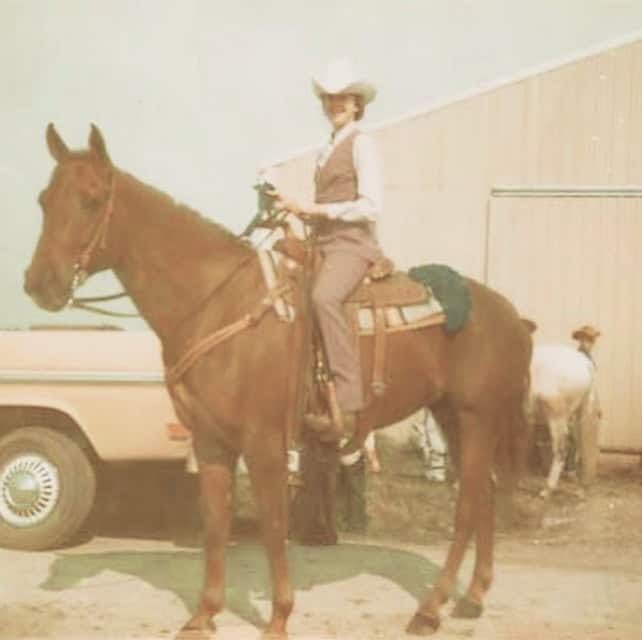
Chubby was a sorrel, which means he was all one color – a reddish brown. He had no white markings and his mane was the same color as his body hair. He had a tiny scar on his withers from where he had turned himself upside down as a colt in a horse trailer.
His dam was Deb’s Chubby and his sire was Illini King Hand, a national Western style show horse champion. Dave had shown Chubby with some success locally, and had trained him well.
He was no beauty as horses go, but Chubby had an easy gait to match his easy disposition. He was the perfect horse upon which to learn how to ride.
I took to Western style riding naturally and Kathy was a good teacher. She was patient and firm and also showed me how to take care of Chubby.
Not only did I spend hours riding him, but I also spent hours grooming him. The barn became my home away from home and during warm months, would often ride my bike four miles on a dirt road to get there and back.
I loved to brush Chubby and give him baths. Now that I think about it, he must have liked it, too – who wouldn’t want a brush massage every day?
Mind of His Own
Although Chubby was an easy-going horse, he did have a few personality quirks. Sometimes he would refuse to load into the horse trailer, balking at the last minute when being led up to it (hence the reason for the scar I mentioned before).
He also had a bad habit of taking off and chewing up the blankets I put on him in the winter. Either he was bored or Chubby just didn’t like the idea of the blanket, but nine times out of ten, it ended up in a wad on the floor of his stall.
I also learned never to turn Chubby out into the dirt-floor arena after I had brushed and/or bathed him, because one of his favorite things to do was to roll on his back in the dirt. He could roll all the way over, too — which my Grandpa Willie always said was a sign of a good horse.
Chubby also couldn’t stand to walk out of sight of the barn. In a horse trailer, he was okay, but the few times I tried to walk down the road with him, he whinnied and cried the whole time until we returned.
My First Horse Show
Soon after my lessons began, Kathy encouraged my dad to let me compete in horse shows. The first show I participated in was at the University of Illinois in Champaign. It was a two-day show, the first of which was for registered quarter horses only, which meant that the competition was much stronger.
Chubby and I were in the 13 and under Western Equitation event, where you are judged on how you ride the horse. The judge makes all of the riders and horses walk, trot, and canter around the arena. Then, he brings them into the center of the arena and makes each horse and rider back up – one at a time.
Sometimes, the judge also makes the riders and horses do another exercise, like a figure eight. Then, he stands behind the line of horses and riders and decides who will place first, second, third, fourth, fifth, and sixth.
Chubby and I placed sixth in our first event together.
The next day, we competed in an open horse show at the same arena and took first place in the 13 and under Western Equitation. I was hooked. I joined 4-H Club and Chubby and I competed for the next two or three years in many horse shows with modest success.
We went to the Illinois State Fair in Springfield, up to a major show in Northbrook, and even over to one in Carmel, Indiana several times. My parents, and sometimes my older sister Sue and little brother Eric came to watch, but often I just went to the shows with Kathy and her husband Kevin.
There were always other kids I knew at the shows and I quickly became aware of the competition. Chubby and I generally did pretty well at open shows, but the registered quarter horse shows were much harder.
There were kids at these shows that who were competing at a national level, with full-time trainers, horses that cost twenty times what Chubby cost, fashionable clothes, and expensive tack. Their parents paid for advertisements in the Quarter Horse Journal – a magazine I read cover to cover every month – and their names were regularly printed in the published show results.
I’m proud to say that Chubby and I got our names printed in the QHJ published show results twice. Every ribbon and trophy that we won required a lot of hard work.
A Better Horse?
Before each show, I spent hours practicing with Chubby — grooming him and polishing his tack. My dad always made me do extra work around the house to buy things like silver decorations for my saddle or fancy show halters. Probably, if I’d pushed a little harder, I could have gotten my parents to agree to let me go to a national show.
But I really didn’t have a good enough horse.
So, when Chubby began to go a little lame (as horses are prone to do), we sold him and went off in search of a better horse. I felt that a piece of me left with him when I saw his new owners drive away with him in their horse trailer.
We paid a hefty $5,000 for my next horse, Sur Miss (a.k.a. Missy), but she had nowhere near the heart that Chubby did. Missy was high-strung and difficult and I never had much success with her.
Within a year, she, too, went lame and we sold her for a loss at an auction. I had no regrets watching her leave the auction arena. Most likely, I would have been able to persuade my dad to buy another horse that would allow me to compete nationally.
But I was ready to move on, to start college in the fall.
I occasionally have dreams about Chubby in my sleep and am grateful that my parents gave me the opportunity to own a horse. Among other things, it taught me responsibility, humility, and that you can have lots fun even if you don’t always win.
And, although I finally threw away my horse trophies a few years ago, I still cannot bring myself to give away all those Breyer horse models upon which those dreams of owning my own horse were built. Maybe someday I will have a grandchild who will love them as much as I did.