
I went to Egypt earlier this month to see the pyramids. But I saw and experienced so much more.
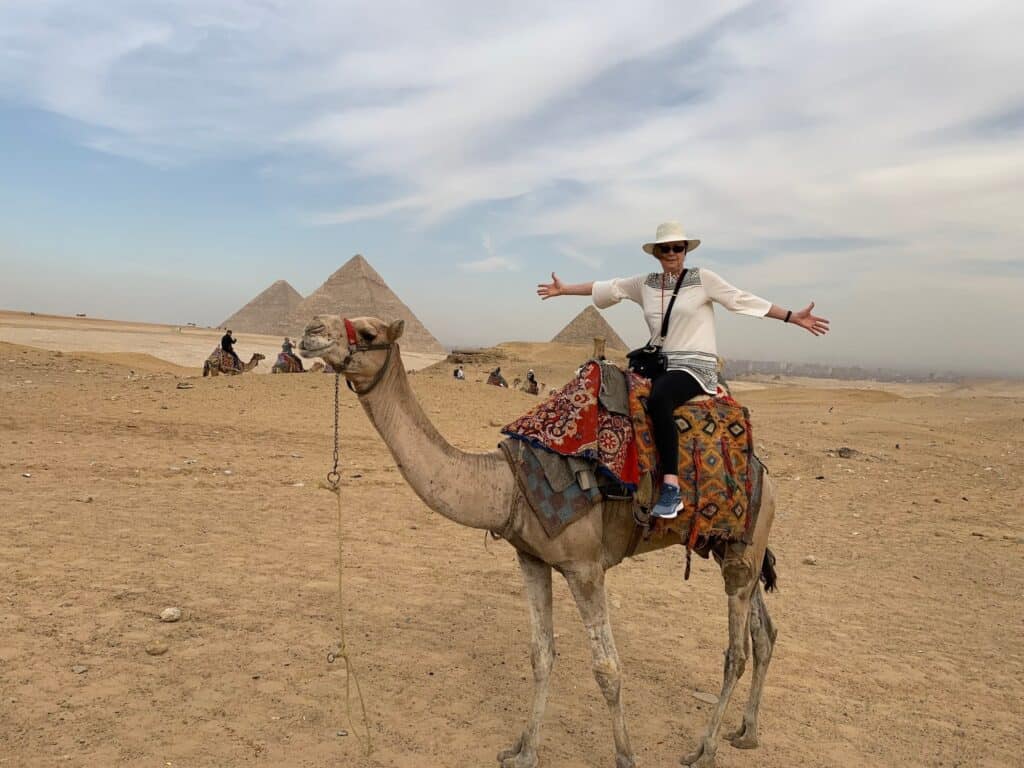
Here are 10 things you might not have known about this ancient modern country and its mystical people.
1. There are no traffic laws

Because of this, they drive like maniacs in the cities and constantly honk at each other. I saw motorcycles drive on the sidewalks and horse drawn carriages compete for road space with cars and tuk-tuks.
Also, there are no pedestrian crossings.
To cross a wide street, you just go, weaving your way between the oncoming honking cars, hoping they don’t hit you. I did this four times in Cairo — each time vowing to myself, “Never again,” but doing it anyway. Crazy.
2. They were great builders — 4,000 years ago
The Giza pyramids are an engineering marvel and remain mostly intact. Each piece of stone is set at an almost perfect right angle. They built them one level at a time, using sand to move up to the next level and removing it when they finished.
We also saw eight different temples on our 14-day trip. Although they all have huge columns and walls covered with once-colorful hieroglyphics and carvings, each is totally unique to its god or goddess.

One of my favorites was the Dendera Temple complex. Its main temple is the temple of the Cow Goddess, Hathor, who is shown wearing a crown of cow horns surrounding a solar disk.
You can see the once vivid colors of the carvings on some of the temple’s restored ceilings. I also liked the carving of Cleopatra on the back of its outside wall. And the large walled-in rectangular swimming pool next to it where the high priestesses swam in private.
Our guide Amal told us creepy stories of people seeing ghosts and hearing music in Dendera, which made it even more intriguing.
While the ancient Egyptians spent hundreds of years building their temples and tombs, they always finished them. Modern Egyptians are a different story.

Much of the cityscapes look like a bombed out war zone.
That’s because in the cities, they build their multi-family houses one level at a time, leaving the upper stories unfinished until one of their children gets married and moves into the next level. It often takes generations to finish a house.
Why do they do this? To save money, of course. They are only taxed on the completed part of their house.
3. They had a woman pharaoh
Egypt had many queens, but none had the full powers of a pharaoh before a woman named Hatshepsut in 1479 B.C., who was a force to be reckoned with.
The daughter of Thutmose I and wife of her half brother and heir to the throne, Thutmose II, Hatshepsut claimed that her father intended for her and her husband to rule jointly, so she insisted on taking on many royal responsibilities.

After Thutmose II died, she proclaimed her divinity and was crowned. To reinforce her position in a male-dominated society, she dressed like a man, wearing the ceremonial garb of a pharaoh in public.
Hatshepsut also sent her stepson Thutmose III off to priest school so he couldn’t assume the crown until she was ready to give it up.
Which was like never.
After her death when Thutmose III became pharaoh, he was so mad at Hatshepsut that he went to extremes to obliterate all traces of her — chiseling off all her images and demolishing her statues. She disappeared from history until 1903 when her tomb was discovered and her story was shared for the first time in 3,500 years.
4. They have a huge garbage problem
There is visible trash and garbage in all of the cities and villages we visited in Egypt — much of it plastic.

It’s floating in certain parts of the Nile and scattered around homes and buildings everywhere. I saw a dead mule bobbing among a bunch of trash in a canal next to a main road lined with residences — the same canal where a couple of men were fishing.
Amal says it has gotten worse after the last revolution in 2011 and that lack of education is a big part of the problem. People think that it is unclean to put their trash in cans near their houses so they just throw it in the canals.
And of course, we tourists contribute to the plastic problem. Although tap water is clean enough to drink, tour companies like Viking discourage this because it has so much chlorine in it that it makes us sick.
So they give us water in bottles. Sigh.
I did see some men in the village of Esna collecting and sorting plastic bottles, which I assumed they were going to recycle.
But we all know that plastic recycling isn’t the best answer to this problem. We need to reduce.
5. They are super-aggressive salespeople
When it comes to selling goods to tourists, Egyptians are unrelenting. Almost every historic site we visited had vendor areas we had to pass through in order to get to the temple, tomb, or whatever.
Running this gauntlet was daunting. Because even if you looked at something (and it was all the same stuff everywhere), they would get in your face and start badgering you.

“Lady, you want a shirt? Ten dollar.”
“You want a tablecloth? Twenty dollar.”
“Pants, I have nice pants. You like? You come look.”
“Bracelet, you want a bracelet? One dollar. ONE DOLLAR!”
The best thing to do was to say “no thank you” and not make eye contact. But that didn’t really deter them.
The thing is, they don’t really understand how to sell to American women. We like to look and ask questions before we buy. If they’d let us do that, we’d probably buy more.
They love to bargain, though. It’s a game for them.
The few times I bought stuff, I followed Amal’s instructions for bigger ticket items to offer less than half of what they wanted.
“When they say no, you start to walk away,” she said. “If they walk you how much, you ask them for their best price. Then you offer something in-between until you get to a price you agree upon.”
Amal was great at telling us how much we should pay for things and spotting quality items that we might like from vendors that followed us to the bus.
“Anybody want a scarf? Three dollars,” she said, waving them in the air in the front of the bus. We bought all of them.
6. King Tut was not a big deal
Thanks to Steve Martin, we Americans all know about King Tutankamen. But as far as Egyptian kings go, the boy king who only ruled for about nine years was very minor.
Ramses II, who ruled for 66 years and Thutmose III, who created the largest empire Egypt had ever seen, are much more revered by Egyptologists.

King Tut is only a big deal because his tomb was found intact. All 64 others in the Valley of the Kings and the tombs in the pyramids had been robbed of their treasures long ago.
I saw the King Tut exhibit at the Field Museum in Chicago in 1977. But the only artifact I remember seeing is the iconic golden mask that covered King Tut’s mummified head.
When I saw the mask again at the much-less crowded Cairo museum more than 40 years later, it was absolutely breathtaking. I was so close I could have touched it had it not been encased in glass. (We could not take pictures of it because the photo copyrights are owned by the Germans!)
There were more than 5,000 items in King Tut’s tomb—only a fraction of which are on display in Cairo. Besides all the gold stuff, there were also extra pairs of underwear. Egyptians really wanted their kings to be prepared for the afterlife.
And according to Amal, every Egyptian king had a tomb filled with treasures and practical things like this. Most were much larger than King Tut’s. It’s hard to even fathom what must have been in them.
7. Egyptian sandstorms are just as bad as American snowstorms

They day we were supposed to leave Luxor to fly back to Cairo in order to catch our flight home the next morning, the wind started blowing. Hard.
We were already at the Luxor airport checked through to the gate. But you couldn’t even see the tarmac. It had turned into a full-blown raging sandstorm.
The next Viking guests who were to take our place on the ship were already in the air on their way from Cairo to Luxor. But their plane had to turn back.
So we got to go back to the ship and eat their lunch, sleep in their beds (which had been our beds) and wait out the storm, which didn’t subside until the next morning. Schools closed, roads closed, airports shut down, and boats were docked.
We all missed our flights.
But, up until that stupid sandstorm, we had a wonderful trip. We met some nice people and were treated like kings and queens by Viking. All of us in Group B felt that our guide Amal was one of the best we’ve had on any of our trips.
We were lucky to have made it there and back, though. And to have taken the last cruise on the Nile for awhile.
P.S. Please do me a favor. If you liked this post, please share it with others by sending them the link or posting it to your Facebook, Twitter, Instagram, etc. Thanks!