
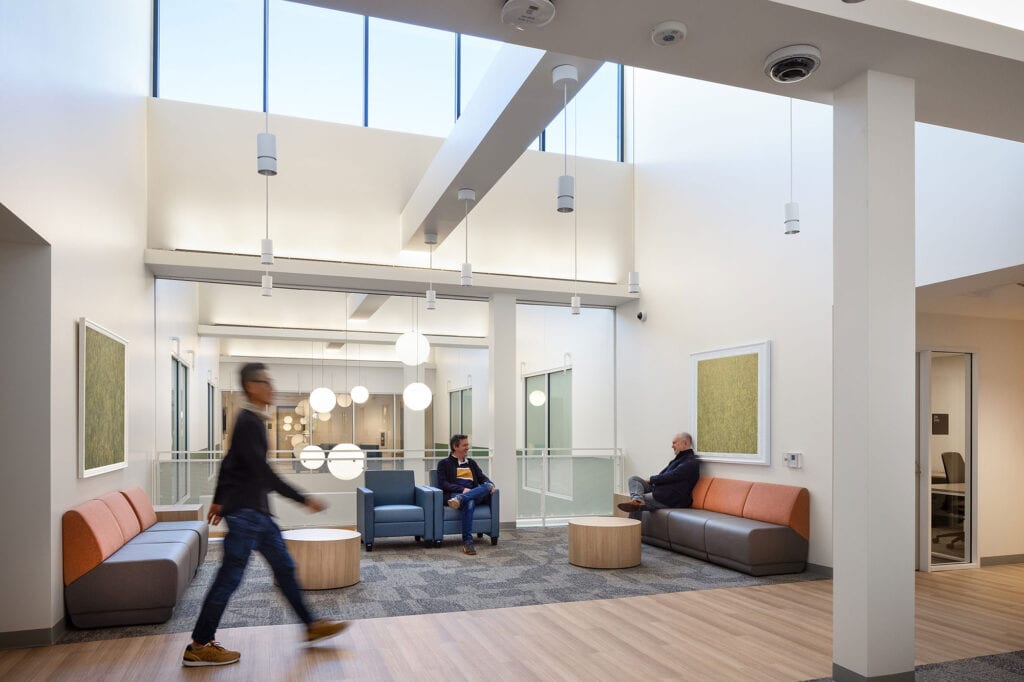
Last week at an event hosted by the International Interior Design Association (IIDA) and the American Institute of Architects Chicago (AIA Chicago), I heard architects and designers talk about one of my favorite subjects: healthcare design.
The conversations reminded me that healthcare design is evolving from institutional, clinical environments to community-integrated, experience-driven ecosystems — but the industry must better balance cost, safety, technology, and storytelling to fully realize its impact.
Here’s four key insights:
1. Fancy-Schmancy
There is some backlash to “luxury” in healthcare environments. It can feel expensive, misaligned with care priorities, and even uncomfortable or untrustworthy to patients who come from different socio-economic backgrounds.
Design for all should feel intentional and human, not fancy.
2. Timing is Everything
Good patient experiences respect the patient’s time. That means designing spaces that facilitate easy wayfinding, intuitive flow, and efficient movement through the facility — minimizing confusion, delays, and unnecessary stress.
It also means creating operational protocols that reduce the time it takes to check in and see the clinician.
And, you cannot design a great patient experience without designing a great staff experience, too.
3. Design as an Enabler for Tech
Technology is reshaping the experience, but needs design integration. The challenge is to design the infrastructure upfront and balance technology with human interaction.
Design must become an enabler of tech + human connection, not one or the other.
4. Healthy Building – Huh?
Environmental responsibility is invisible to patients and under-communicated. Healthcare systems are not telling the story of how buildings support health, safety, and well-being.
We still need better data around ROI to convince decision-makers to invest in newer concepts such as circadian lighting, biophilic design (beyond just plants), neuro-inclusive design, etc.
Reasons to be Optimistic
Finally, the architects and designers who spoke at this event are optimistic about:
- Younger designers entering healthcare
- Advances in materials + technology
- Neuroscience-backed design decisions
- AI as a research and insight tool
- Shift toward prevention and relationship-based care
The Last Word
Clearly, healthcare design is doing more than ever to support the human experience — but much of that impact remains invisible or misunderstood. If we want patients and staff to trust the environments we create, we need to do more than design them well.
We need to explain them, too.
What do you think?
Want More?
Here’s some of my other posts that speak to some of these issues:
How Design Shapes Brains: Neuroarchitecture and the Future of Public Health
Healthy Buildings Aren’t a Luxury: They’re Core to Our Health & Well-Being
From Patient Experience to Human Experience: What Really Matters in Healthcare Design
P.S. Please do me a favor — if you liked this post and like this blog, please share it with others by sending them the link or posting it on your LinkedIn, X, or Facebook. Also, don’t forget to subscribe, so you’ll get emails when new content is posted. Thanks!
Photo: Franklin Residential Care Facility & Behavioral Health Clinic, Riverside, Calif., designed by Gensler.