
ESG in senior living can feel like a buzzword these days—until you meet someone who actually knows how to make it meaningful. Every so often, I come across a leader who isn’t just talking about impact but is reshaping what an environmental, social, and governance framework it looks like in practice.
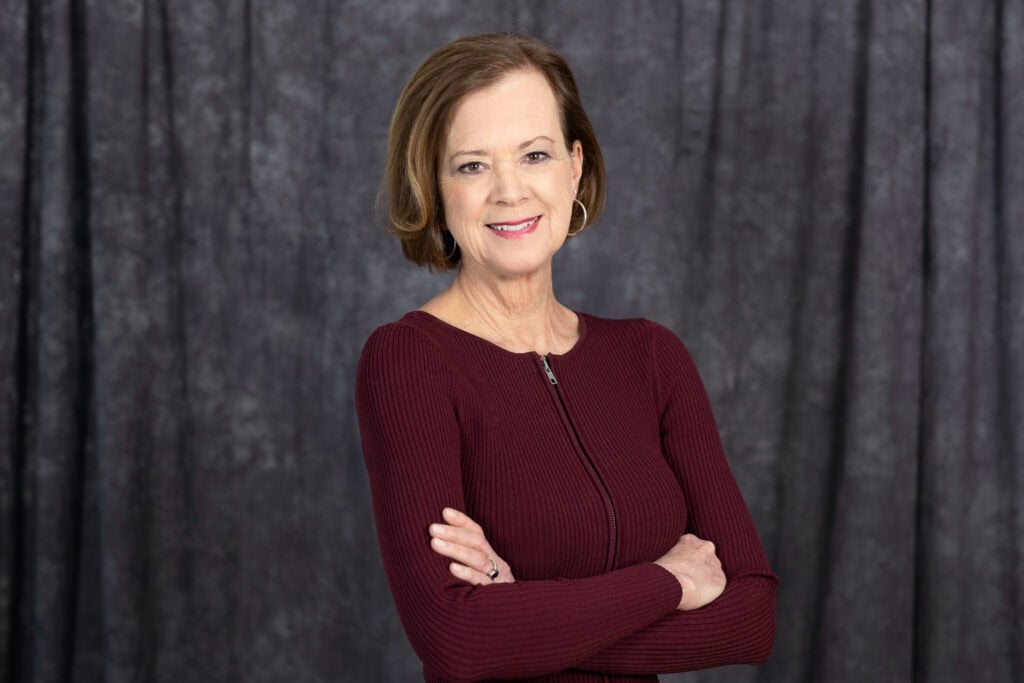
Jill Brosig, Senior Managing Director and Chief Impact Officer at Harrison Street, is one of those people. She’s data-driven, deeply curious, and refreshingly practical—exactly the kind of perspective ESG in senior living has been missing.
Harrison Street has over $108 billion in assets, including 32,200 senior living units and 12.7 million square feet of medical office space in the U.S.
Jill didn’t start in real estate. She started as a physicist, working in national labs on projects that intersected with environmental impact, including one that involved a particle detector “spewing freon into the atmosphere.” Later she moved into fusion research—“how the sun makes energy”—before transitioning to Motorola and eventually Harrison Street.
Her operational mindset became quickly valuable. Applying Six Sigma, she helped partners diagnose underlying issues, including a memorable case of nurse turnover traced not to culture or pay but to insufficient confidence in backup staff. The fix? Better training and systems—not assumptions.
ESG As A Differentiator
Given the political blowback surrounding ESG these days, I asked Jill whether Harrison Street had softened its strategy. “We’ve doubled down,” she said. “For us, it’s a differentiator.”
To her, the backlash isn’t evidence that ESG is misguided—it’s evidence that people are arguing about undefined terms. “We do this because it creates a better-performing product,” she says. And the numbers back it up: Harrison Street invested $51 million in utility enhancement ESG initiatives that resulted in over $225 million in value creation.
How refreshing is that? So many firms still treat ESG as a public relations tactic or a moral box-check. Brosig treats it as an operating framework—one rooted in measurable performance and the lived experience of residents and staff.
The Future Depends on Better Definitions
When I ask her where ESG is headed, she doesn’t talk about politics or branding. She talks about clarity.
“Seventy percent of projects fail because they were never defined properly,” she says.
Jill is equally passionate about the social side of ESG. Harrison Street has partnered with Maastricht University, the co-founders of GRESB (Global Real Estate Sustainability Benchmark) to develop a scorecard that evaluates how the built environment impacts residents, workers, building management, and the surrounding community. “It’s a scorecard, but more powerful as a tool to see how you continuously improve.”
Notably, DEI sits not in the S, but in the G for Harrison Street—reflecting how the firm governs, promotes, and manages its people.
Embodied Carbon: The Complex, Necessary Frontier
One area where definitions still lag is carbon. In a recent joint paper with Gensler, Brosig advocated for a whole-life carbon approach. Operational carbon is relatively straightforward to measure, but embodied carbon—the carbon footprint of materials and manufacturing—remains complex.
“For older buildings, we often have no way of knowing where the carbon came from,” she says. The measurement infrastructure simply isn’t mature enough yet, especially on the interiors side where most materials lack robust data.
This is exactly the challenge I see in the interiors world, where designers are expected to produce carbon calculations for complex assemblies that manufacturers have never quantified. The infrastructure for this is still being built.
Still, Harrison Street is moving ahead with pilots in Europe and plans to incorporate embodied carbon more explicitly into its next five-year strategy. “It’s not perfect, but it’s a start,” she says.
Healthy Buildings for Seniors: Finally a Framework
Harrison Street now has more Fitwel certifications than any other firm in the world. While Fitwel lacked a senior living-specific scorecard, Brosig and her team recognized the gap.
“Fitwel’s mission is ‘healthy buildings for all,’ but they had never considered the senior market,” she recalls. Harrison Street collaborated with them to develop the first-ever senior living scorecard—now the most complex in Fitwel’s system.
Even better: they made it available for the whole industry, not just their own portfolio.
Research That Actually Improves Lives
What excites Jill most today is Harrison Street’s expanding research partnerships. A recent study with Mayo Clinic examined enhanced circadian lighting in senior communities. The results (which haven’t been published yet) are better sleep, stronger cognitive function, and improved well-being.
Many of Harrison Street’s properties already have baseline circadian lighting, but most aren’t using it optimally. “If they ramp it up,” she says, “the impact could be significant.”
This is the kind of insight senior living needs—practical innovations that directly influence resident health and experience.
A Human Touch
When I ask what she enjoys outside work, she says, “Fashion is my vice—boutique shopping.” It’s a reminder that leaders in sustainability and impact can have personality, preferences, even playful vices.
P.S. Please do me a favor — if you liked this post and like this blog, please share it with others by sending them the link or posting it on your LinkedIn, X, or Facebook. Also, don’t forget to subscribe, so you’ll get emails when new content is posted. Thanks!